---
title: "Generative AI for Associations: The Complete Practical Guide | Cimatri"
description: A comprehensive guide to generative AI for associations. Cover member engagement, prompt engineering, privacy, vibe coding, ethical considerations, and building an AI usage framework.
image: https://cimatri-3869211.hs-sites.com/hubfs/Website/blog-hero-vibe-coding-what-association-executives-need-to-know-before-they-dive-in.png
---
[Skip to main content](https://cimatri-3869211.hs-sites.com/blog/complete-guide-generative-ai-practical-applications-associations#main-content)
[ ](https://cimatri-3869211.hs-sites.com/)
- [About](https://cimatri-3869211.hs-sites.com/about/)
- [Markets We Serve](https://cimatri-3869211.hs-sites.com/markets-we-serve/)
- [Our Team](https://cimatri-3869211.hs-sites.com/our-team/)
- [SCALE Framework](https://cimatri-3869211.hs-sites.com/scale-methodology/)
- [What Our Clients Say](https://cimatri-3869211.hs-sites.com/what-our-clients-say)
- [Services](https://cimatri-3869211.hs-sites.com/services/)
- [Consulting](https://cimatri-3869211.hs-sites.com/consulting/)
- [Managed Services](https://cimatri-3869211.hs-sites.com/concierge-it/)
- [Intelligence](https://cimatri-3869211.hs-sites.com/cimatri-intelligence/)
- [Tools](https://cimatri-3869211.hs-sites.com/tools/)
- [Resources](https://cimatri-3869211.hs-sites.com/resources/)
- [Read Our Blog](https://cimatri-3869211.hs-sites.com/blog/)
- [Free Resources](https://cimatri-3869211.hs-sites.com/resources/)
- [Newsletter](https://cimatri-3869211.hs-sites.com/newsletter/)
- [Ethical AI for Associations](https://cimatri-3869211.hs-sites.com/ethical-ai-for-associations/)
[Contact Us](https://cimatri-3869211.hs-sites.com/contact/)
[Home](https://cimatri-3869211.hs-sites.com/) › [Blog](https://cimatri-3869211.hs-sites.com/blog) › Generative AI for Associations: The Complete Practical Guide
# Generative AI for Associations: The Complete Practical Guide
**Rick Bawcum**
June 13, 2026
## The Generative AI Opportunity for Associations
Generative AI tools have fundamentally changed how organizations communicate, create content, and solve problems. For associations and nonprofits, these tools offer tremendous potential — from drafting member communications and generating policy summaries to building custom software and automating entire workflows. But realizing that potential requires more than just signing up for an account. Leaders need to understand the practical applications, protect their organization’s data, master the art of effective prompting, and establish governance frameworks that match the pace of innovation.
This guide brings together Cimatri’s expertise on generative AI into a comprehensive resource covering the applications that matter most for associations — from personalized member engagement to AI-assisted development — along with the privacy, ethical, and governance considerations that responsible adoption demands.
## How Generative AI Enhances Member Engagement
Generative AI is redefining how associations connect with their members, enabling highly customized communication, learning opportunities, and outreach. By applying AI capabilities thoughtfully, associations can deliver the right content to the right audience, boosting engagement and satisfaction while easing operational burdens.
**Dynamic content creation.** AI enables personalized email campaigns and newsletters that reflect each member’s unique preferences. Rather than sending identical communications to your entire membership, generative AI can tailor messaging based on individual interests, engagement history, and professional focus. This ensures communications remain relevant and avoids the information fatigue that drives members to disengage.
**Curated event experiences.** By analyzing past attendance and behavior patterns, AI can suggest specific sessions or networking opportunities, creating customized agendas that improve event participation and perceived value. Members receive recommendations aligned with their interests rather than generic event guides, making the conference experience feel personally designed for them.
**Personalized learning paths.** Generative AI can create individualized learning paths, recommending courses or training modules aligned with a member’s career goals and interests. Microlearning content — short, focused educational modules — can be generated and adapted based on each learner’s pace and preferences, making continuing education more accessible and effective.
**Predictive engagement models.** AI can identify members who may not renew and automatically trigger engagement efforts, such as personalized reminders or special renewal incentives. By recognizing patterns in member behavior before disengagement becomes visible to staff, associations can intervene proactively rather than reactively.
**Content creation at scale.** Blog posts, social media content, newsletter articles, event descriptions, grant proposals, and training materials can all be drafted more efficiently with generative AI assistance. The key is using AI as a collaborator that accelerates the creative process while maintaining human editorial oversight and organizational voice.
## Mastering Prompt Engineering
The quality of what you get from generative AI is directly proportional to the quality of what you put in. Prompt engineering — the practice of crafting well-structured inputs to achieve desired outputs — is a skill every association professional using AI should develop.
A well-constructed prompt helps the AI model understand your context, reduces ambiguity in responses, and allows you to specify the exact format you need. The difference between a vague prompt and a precise one can mean the difference between a useless paragraph and a polished, actionable deliverable.
### Essential Prompting Practices
Be explicit about your requirements and provide sufficient context. Rather than asking “write something about membership,” specify the audience, the tone, the purpose, and the length. The more precisely you describe what you need, the closer the initial output will be to what you can actually use.
Specify the output format you need — whether that is a bulleted list, a formal summary, an email draft, a data table, or a social media post. Frame prompts as clear questions or requests to engage the model effectively. Experiment with rephrasing when initial results do not meet your expectations; often a slight adjustment in how you ask produces dramatically different results.
Control response length by stating the desired word count, number of sentences, or paragraph structure. And always review AI-generated content before using it in any official capacity — generative AI is a powerful drafting tool, but your organization’s expertise, judgment, and mission-driven perspective remain essential.
### Building Iteratively
Most generative AI tools maintain context within a conversation, which means you can build on previous responses. Reference earlier outputs to create a conversational flow, ask the model to correct or revise its work, and request clarification or expansion on specific points. This iterative approach is particularly powerful for complex tasks like drafting policy documents, developing multi-part member communications, or building comprehensive reports.
## Privacy and Data Governance
Associations and nonprofits handle sensitive member data, financial information, and strategic documents daily. Before integrating generative AI into your workflows, understanding how your data is handled is essential.
### Controlling Your Data
AI providers offer various mechanisms for managing how your information is stored and used. Activating privacy-focused settings can prevent your conversations from being used for model training. For organizational use, enterprise-tier subscriptions typically offer additional data governance controls that associations should evaluate carefully. Review and understand the data retention policies of every AI tool your team uses.
### Establishing Clear Boundaries
Even with privacy settings enabled, it is critical to establish internal policies about what types of information staff may and may not share with AI tools. Avoid entering sensitive or personally identifiable member information into any AI system. Be aware that AI providers may log certain interaction data. If your organization’s publicly available information exists online, AI models may reference it in responses to other users.
### Vetting Third-Party AI Tools
As generative AI technology is embedded into an expanding ecosystem of applications, the privacy landscape grows more complex. Before adopting any tool that leverages AI APIs, review its permissions, read its privacy policy, understand any associated costs, and research the developer’s track record. Your association’s IT governance framework should include a vetting process for AI-powered third-party tools.
## Understanding AI Behavior Over Time
One of the most important — and least understood — aspects of working with generative AI is that model behavior is not static. AI models evolve through continuous updates, and those changes can significantly affect the quality and consistency of outputs your organization depends on.
Research from Stanford University and UC Berkeley examined how major AI models performed across diverse tasks at different points in time. The findings were striking: model performance varied dramatically. In one case, an AI model’s accuracy on a mathematical task dropped from approximately 98% to roughly 2% over just three months, while a different model improved on the same task during the same period.
This carries important implications. First, AI is not a set-it-and-forget-it tool. Workflows that rely on consistent AI outputs need ongoing monitoring to ensure quality has not degraded after a model update. Second, transparency matters — ask your AI vendors about their update practices and how changes might affect behavior. Third, build contingency plans into AI-integrated systems so that a sudden shift in model behavior does not disrupt critical processes like member communications or data analysis.
## Vibe Coding: AI-Assisted Development for Associations
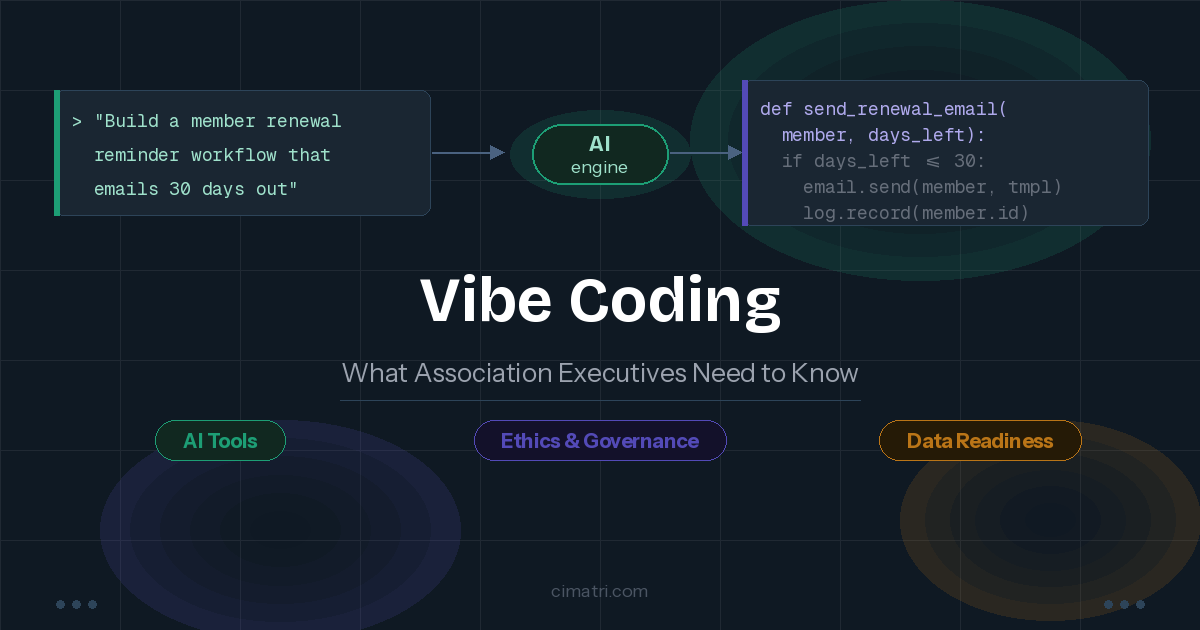
A quiet revolution is happening in how software gets built, and it is moving faster than most association leaders realize. “Vibe coding” — a term coined by Andrej Karpathy, co-founder of OpenAI — describes a mode of software development in which a person describes what they want in plain language, and an AI coding assistant generates the actual code. The human’s role shifts from writing syntax to directing intent.
In practice, vibe coding looks something like this: you open an AI tool, describe “build me a member event registration form that connects to our database and sends a confirmation email,” and the system produces working code. You review it, refine your prompts, test the output, and iterate. At no point do you necessarily write a single line of code yourself.
### Why This Matters for Associations
Associations are not software companies, but every association already delivers digital experiences to its members — portals, registration systems, credentialing workflows, resource libraries. Most operate with lean staff, stretched budgets, and a genuine need to do more with less. Historically, that has meant choosing between expensive custom development, rigid off-the-shelf platforms, or simply going without.
Vibe coding introduces a third path: mission-aligned staff who can build tools, automate workflows, and prototype new member services without waiting months for a vendor or spending six figures on a developer. The use cases are real and growing — member-facing calculators, event registration workflows, internal automation connecting systems that do not talk to each other, board portals, chapter communication tools, and lightweight dashboards.
### Skills and Capabilities Needed
Vibe coding lowers the floor of software development dramatically, but it does not eliminate the need for judgment, context, and accountability. The people best suited to vibe coding in an association context are analytically comfortable — able to read code outputs at a high level and recognize when something looks wrong. They need strong problem-definition skills, because the quality of AI output is directly proportional to the clarity of the prompt. And they must cultivate productive skepticism, because AI models confidently produce incorrect code, miss edge cases, and make security errors.
To experiment and prototype, the bar is genuinely low — curiosity, a willingness to feel temporarily uncertain, and the ability to describe a problem clearly are sufficient. Many association staff discover they can produce a working first result within hours. The higher bar applies when it is time to deploy and maintain what gets built, which is where analytical comfort, rigorous testing, and security awareness become essential.
### The Cost Equation
The leading AI coding tools range from free tiers to modest monthly subscriptions. Hosting lightweight internal tools on cloud platforms can cost as little as a few dollars per month. Compared to the cost of even a few hours of custom development, the economics are striking. But the real cost equation is about staff time — vibe coding requires investment in learning, oversight, and ongoing maintenance. Organizations that treat it as “free software development” will be disappointed. Those that think of it as a way to multiply the capability of curious, capable staff at a fraction of traditional development costs will find the value proposition compelling.
### Risks and Guardrails
AI-generated code frequently introduces security vulnerabilities that trained developers would catch — injection vulnerabilities, improper input validation, insecure credential handling. Because vibe coding makes it easy to produce large volumes of code quickly, it can also produce large volumes of risk quickly. Any code that touches member data, authentication, or external integrations should be reviewed by someone with security expertise before deployment.
Maintenance burden is easy to underestimate. Code generated quickly can be difficult to understand, modify, or debug later. Without documentation and version control, vibe-coded tools can become technical debt faster than traditionally developed ones. And as AI tools grow more capable, the line between code generation and autonomous agents — systems that can take actions on your computers, read files, send messages, and interact with organizational systems — is blurring. Organizations should ensure their AI governance policies address agent tools specifically, not just chatbot-style assistants.
## Ethical Considerations
Associations leveraging generative AI must balance innovation with ethical responsibility. Several considerations deserve explicit attention from association leaders.
**Data stewardship.** When staff use AI tools that interact with member data, that data may be exposed to third-party systems. Organizations must understand the data policies of every tool they use, and staff must be trained never to include real member information in prompts or testing environments.
**Transparency.** If your association uses AI to create member-facing content, build tools, or automate communications, stakeholders deserve to understand that. Openness about your methods reinforces trust rather than undermining it.
**Accountability.** When an AI-generated output produces incorrect information, loses data, or creates a poor member experience, the organization is responsible — not the model. Staff must understand themselves as the authors of what AI produces, not merely the operators of it.
**Bias mitigation.** AI systems can introduce unintended bias that impacts member experiences. Developing internal protocols to monitor AI outputs and employing fairness tools ensures equitable and inclusive communication. For associations committed to diversity, equity, and inclusion, regular auditing of AI-driven interactions is essential.
**Equity of access.** AI tools are not uniformly accessible across staff skill levels or comfort with technology. Associations committed to inclusive workplaces should be intentional about who gets access to these tools, who gets support in learning them, and how the productivity benefits are distributed.
## Building Your AI Usage Framework
Effective use of generative AI requires attention to multiple dimensions. Here is a practical framework for associations establishing their approach to generative AI.
**Establish privacy and data governance policies.** Define what types of information may never be shared with AI tools. Specify which AI platforms are approved for organizational use. Document how AI-generated content should be reviewed before publication. Create a vetting process for third-party tools that incorporate AI.
**Implement monitoring practices.** Track AI performance over time and watch for quality degradation. Review AI-generated outputs regularly for accuracy, bias, and alignment with your organization’s voice. Build contingency plans so that model updates do not disrupt critical workflows.
**Invest in staff development.** Provide prompt engineering training so everyone can extract maximum value from these tools. Give staff protected time to experiment with AI tools in low-stakes environments. Distinguish between experimentation-level skills and deployment-level skills, and do not let the higher bar discourage early exploration.
**Create governance for AI-assisted development.** Define which categories of projects may use vibe coding without professional review and which require security expertise. Establish documentation, version control, and testing requirements for AI-generated tools. Create a clear escalation path for security concerns, integration complexity, or compliance questions.
**Maintain a culture of human oversight.** AI is a powerful assistant, but your organization’s expertise, judgment, and mission-driven perspective remain irreplaceable. Associations that effectively balance AI-driven innovation with ethical considerations will maintain member trust and enhance their value proposition.
## Partner with Cimatri
Cimatri works exclusively with associations and nonprofits, helping organizations navigate every aspect of generative AI — from foundational literacy and privacy governance to hands-on implementation of AI-powered tools and workflows. Whether you are establishing your first AI usage policies, training staff on prompt engineering, or exploring how AI-assisted development can extend your team’s capabilities, our consultants bring deep association expertise and a commitment to responsible, results-driven adoption. [Contact Cimatri](https://cimatri-3869211.hs-sites.com/contact) to start putting generative AI to work for your organization.
Rick Bawcum
### Ready to Transform Your Association's Technology?
Get expert guidance on IT strategy, AI adoption, and digital transformation.
[Let's Talk](https://cimatri-3869211.hs-sites.com/contact)
[ ](https://cimatri-3869211.hs-sites.com/)
We make technology less scary.
#### Links
- [About](https://cimatri-3869211.hs-sites.com/about/)
- [Assessments](https://cimatri-3869211.hs-sites.com/assessments/)
- [Resources](https://cimatri-3869211.hs-sites.com/resources/)
#### Subscribe to our Newsletter
#### Contact Us
[(571) 249-2719](tel:5712492719)
© 2026 Cimatri. All Rights Reserved. [Privacy Policy](https://cimatri-3869211.hs-sites.com/privacy-policy/)
```json
{
"@context" : "https://schema.org",
"@type" : "BlogPosting",
"author" : {
"@type" : "Person",
"name" : "Rick Bawcum",
"url" : "https://cimatri-3869211.hs-sites.com/blog/author/rick-bawcum"
},
"dateModified" : "2026-06-13T14:13:10.326Z",
"datePublished" : "2026-06-13T14:13:10.000Z",
"headline" : "Generative AI for Associations: The Complete Practical Guide",
"image" : [ "https://cimatri-3869211.hs-sites.com/hubfs/Website/blog-hero-vibe-coding-what-association-executives-need-to-know-before-they-dive-in.png" ],
"mainEntityOfPage" : {
"@id" : "https://cimatri-3869211.hs-sites.com/blog/complete-guide-generative-ai-practical-applications-associations",
"@type" : "WebPage"
},
"publisher" : {
"@type" : "Organization",
"logo" : {
"@type" : "ImageObject",
"url" : "https://cimatri-3869211.hs-sites.com/hubfs/cimitri-masterlogo-300ppi-rgbPNG.png"
},
"name" : "Cimatri"
}
}
```
```json
{
"@context" : "https://schema.org",
"@type" : "Organization",
"contactPoint" : {
"@type" : "ContactPoint",
"contactType" : "sales",
"url" : "https://www.cimatri.com/contact"
},
"description" : "Cimatri helps association leaders navigate AI strategy, digital transformation, and IT modernization.",
"logo" : "https://www.cimatri.com/hubfs/Website/CIM-Logos-Standard.png",
"name" : "Cimatri",
"sameAs" : [ "https://www.linkedin.com/company/cimatri", "https://twitter.com/cimatrillc" ],
"url" : "https://www.cimatri.com"
}
```
```json
{
"@context" : "https://schema.org",
"@type" : "WebSite",
"name" : "Cimatri",
"potentialAction" : {
"@type" : "SearchAction",
"query-input" : "required name=search_term_string",
"target" : "https://www.cimatri.com/search?q={search_term_string}"
},
"url" : "https://www.cimatri.com"
}
```
```json
{
"@context" : "https://schema.org",
"@type" : "ProfessionalService",
"areaServed" : "US",
"audience" : {
"@type" : "Audience",
"audienceType" : "Association and Nonprofit Leaders"
},
"name" : "Cimatri",
"priceRange" : "$$$$",
"serviceType" : [ "AI Strategy Consulting", "Digital Transformation", "IT Managed Services", "Technology Assessments" ],
"url" : "https://www.cimatri.com"
}
```