---
title: The Executive's Guide to AI Maturity for Associations | Cimatri
description: A comprehensive guide to AI maturity for association leaders. Learn the six dimensions of the AI Maturity Model, five maturity levels, and how to build your AI roadmap.
image: https://cimatri-3869211.hs-sites.com/hubfs/Website/blog-hero-ai-maturity-guide-for-associations.png
---
[Skip to main content](https://cimatri-3869211.hs-sites.com/blog/ai-maturity-guide-for-associations#main-content)
[ ](https://cimatri-3869211.hs-sites.com/)
- [About](https://cimatri-3869211.hs-sites.com/about/)
- [Markets We Serve](https://cimatri-3869211.hs-sites.com/markets-we-serve/)
- [Our Team](https://cimatri-3869211.hs-sites.com/our-team/)
- [SCALE Framework](https://cimatri-3869211.hs-sites.com/scale-methodology/)
- [What Our Clients Say](https://cimatri-3869211.hs-sites.com/what-our-clients-say)
- [Services](https://cimatri-3869211.hs-sites.com/services/)
- [Consulting](https://cimatri-3869211.hs-sites.com/consulting/)
- [Managed Services](https://cimatri-3869211.hs-sites.com/concierge-it/)
- [Intelligence](https://cimatri-3869211.hs-sites.com/cimatri-intelligence/)
- [Tools](https://cimatri-3869211.hs-sites.com/tools/)
- [Resources](https://cimatri-3869211.hs-sites.com/resources/)
- [Read Our Blog](https://cimatri-3869211.hs-sites.com/blog/)
- [Free Resources](https://cimatri-3869211.hs-sites.com/resources/)
- [Newsletter](https://cimatri-3869211.hs-sites.com/newsletter/)
- [Ethical AI for Associations](https://cimatri-3869211.hs-sites.com/ethical-ai-for-associations/)
[Contact Us](https://cimatri-3869211.hs-sites.com/contact/)
[Home](https://cimatri-3869211.hs-sites.com/) › [Blog](https://cimatri-3869211.hs-sites.com/blog) › The Executive's Guide to AI Maturity for Associations
# The Executive's Guide to AI Maturity for Associations
**Rick Bawcum**
February 07, 2024
## Is Your Association AI-Ready?
In an era where Artificial Intelligence is reshaping the landscape of industries, associations stand at a crossroads. The opportunity to leverage AI for breakthroughs in member engagement, operational efficiency, and innovative leadership is immense. The key to unlocking this potential lies in mastering the AI Maturity Model — a strategic compass guiding organizations from nascent stages of AI familiarity to heights of transformative impact.
This comprehensive guide consolidates our complete AI Innovation Series, walking you through every dimension of AI maturity and providing a clear framework for your association's AI journey.
## The AI Maturity Model: A Strategic Framework
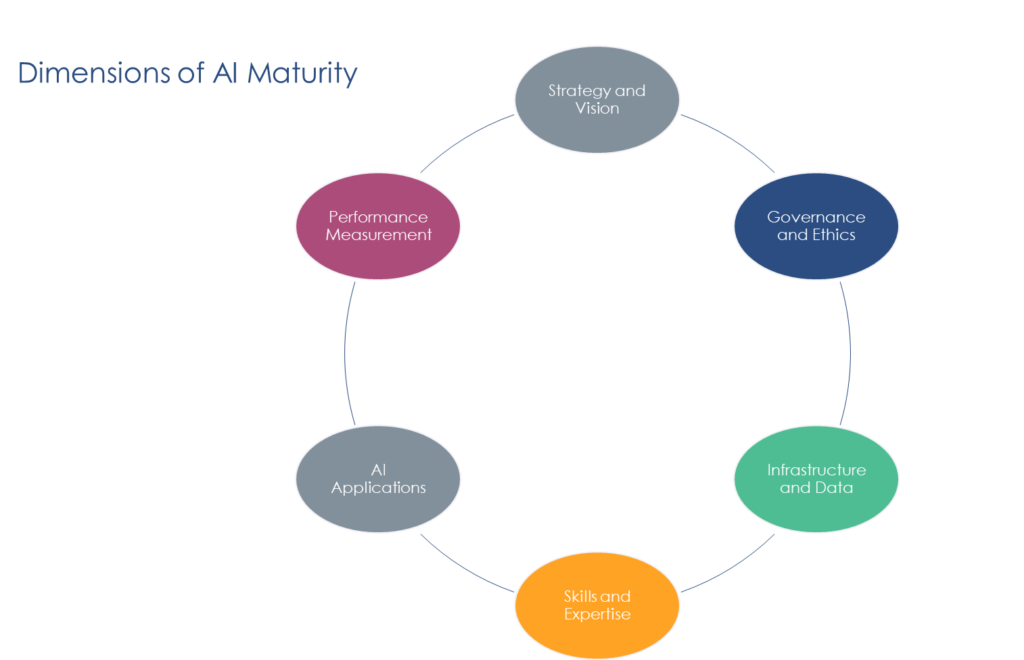
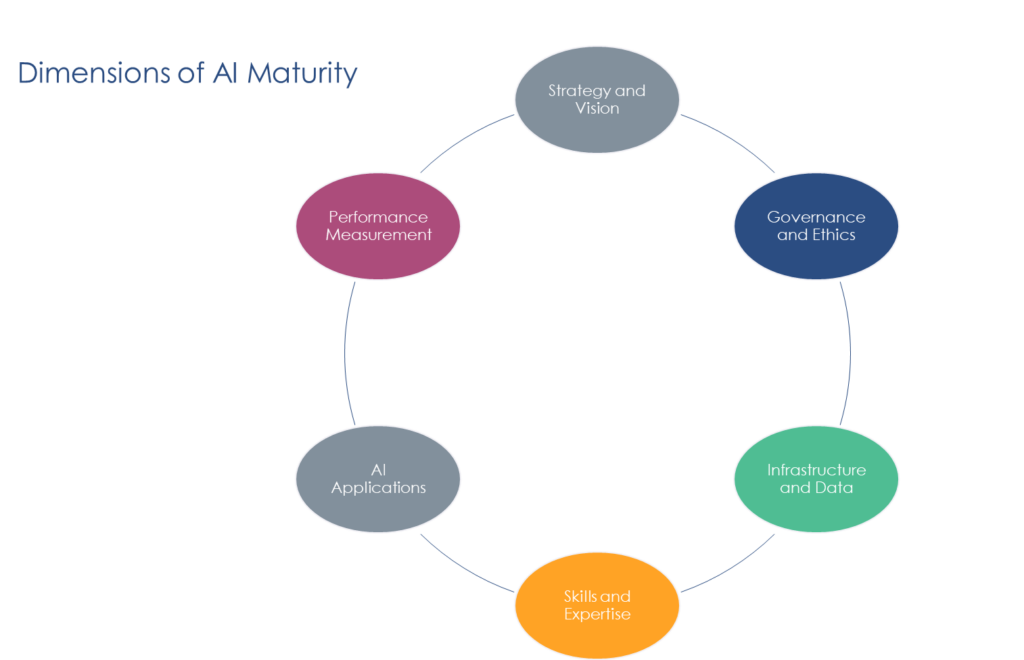
The AI Maturity Model is not just a benchmarking tool; it's a dynamic blueprint for growth. It recognizes that AI maturity is not a destination but a journey of continuous evolution. The model encompasses six critical dimensions and five maturity levels, forming a comprehensive ecosystem of AI excellence.
### The Six Dimensions of AI Maturity
**1. Strategy and Vision** — Beyond mere technology adoption, crafting a visionary AI roadmap is paramount for aligning AI initiatives with organizational goals.
**2. Infrastructure and Data** — The backbone of AI success, where robust infrastructure meets the gold mine of quality data.
**3. Skills and Expertise** — AI is only as powerful as the minds behind it. Cultivating a culture of continual learning and expertise development is essential.
**4. AI Applications** — Translating AI potential into tangible results that elevate member services and operational excellence.
**5. Performance Measurement** — Measuring AI's impact is an art and science, ensuring that AI investments translate into measurable benefits.
**6. Governance and Ethics** — Steering the AI journey with an ethical compass and governance frameworks to uphold trust and integrity.
### Five Levels of AI Maturity
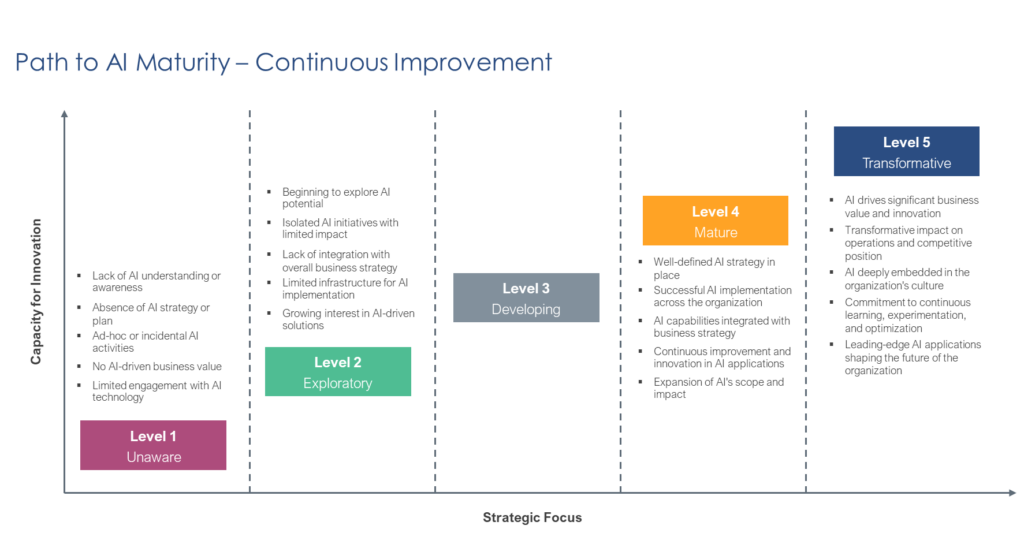
Organizations evolve through five distinct levels of AI maturity:
**1. Unaware** — The initial phase where AI is a distant concept, yet to be explored.
**2. Exploratory** — Curiosity leads to experimentation, though strategic direction may still be nascent.
**3. Developing** — A structured approach emerges, with AI initiatives beginning to take shape.
**4. Mature** — AI becomes a seamless part of the organizational fabric, driving significant value.
**5. Transformative** — AI is a catalyst for innovation and a source of competitive advantage, reshaping the organization's future.
## Dimension 1: Strategy and Vision — Charting the Future
Developing a robust AI strategy involves aligning AI initiatives with the broader goals of the organization. It's about answering fundamental questions regarding the objectives and outcomes of adopting AI. The vision aspect is about envisaging a future transformed by AI — a future where AI not only supports but elevates the core functions of the association.
### Crafting a Comprehensive AI Roadmap
An AI Roadmap is a critical component of the strategy development process. It serves as a detailed guide, outlining the steps needed to achieve your envisioned AI goals:
**Assessment of Current State:** Understanding your current level of AI maturity and identifying gaps in technology, skills, and processes.
**Goal Setting:** Defining specific, measurable objectives that AI initiatives aim to achieve.
**Resource Identification:** Determining the resources — technological, human, and financial — required to meet these objectives.
**Timeline Creation:** Setting a realistic timeline with milestones for the deployment of AI projects.
**Risk Management:** Identifying potential challenges and risks associated with AI implementation and outlining strategies to mitigate them.
### Implementing the Roadmap
With a clear strategy and a detailed AI Roadmap, execution becomes more focused and effective. This involves allocating the necessary budget, personnel, and technology; initiating AI projects based on the roadmap's timeline; and regularly reviewing progress against milestones.
A successful AI strategy and roadmap are living documents that evolve. As the field of AI advances and the association's needs change, revisiting and updating the strategy and roadmap is essential.
## Dimension 2: Governance and Ethics — Building Trust
At the heart of the AI journey is embedding responsibility and ethical decision-making into the very fabric of AI initiatives. As organizations progress through the maturity levels, Governance and Ethics evolve from basic awareness to becoming a cornerstone of AI strategy.
**Building Trust through Responsible AI:** Robust governance and ethical standards are essential in establishing trust in AI systems among all stakeholders.
**Setting Standards and Policies:** This dimension involves formulating and enforcing policies to ensure AI is used responsibly, respecting privacy and equity.
**Risk Management:** Effective governance is key to identifying and mitigating risks associated with AI, including data security and ethical concerns.
### Continuous Improvement in Governance
As AI technology advances, so do the ethical and governance challenges, requiring a dynamic approach to policy development and enforcement. Incorporating feedback from AI implementations, member feedback, and industry trends is essential for refining governance practices. Promoting a culture that prioritizes ethical considerations in AI projects is fundamental for long-term, responsible AI usage.
## Dimension 3: Infrastructure and Data — The Foundation
The journey towards AI excellence is deeply rooted in the strength of Infrastructure and Data. This foundation is not just a technical prerequisite; it's the lifeblood that fuels AI systems.
**Quality Data — The Heart of AI:** The efficacy of AI systems hinges on the quality of data. Accurate, diverse, and well-curated data sets are the foundation upon which AI algorithms learn and make decisions.
**Robust Infrastructure — The Backbone of AI:** A powerful and scalable infrastructure ensures that AI applications can function optimally, handle large datasets, and deliver results efficiently.
**Security and Accessibility:** Ensuring data security and accessibility is paramount, as it not only protects sensitive information but also empowers teams to leverage AI effectively.
As organizations grow in their AI maturity, their infrastructure needs to adapt to support more complex and demanding AI applications. Regularly reviewing and enhancing data quality is a continuous pursuit vital for maintaining the effectiveness of AI systems.
## Dimension 4: Skills and Expertise — The Human Element
The success of AI endeavors significantly depends on the Skills and Expertise within your teams. This dimension is not merely about hiring talent; it's about nurturing an AI-savvy culture underpinned by continuous learning and skill development.
**Foundation Training for Staff:** Equipping staff with basic AI knowledge and skills is crucial. Initiatives like AI bootcamps or workshops can demystify AI and empower staff to contribute to AI projects.
**Developing Specialized Expertise:** Beyond foundational knowledge, developing deep expertise in AI fields is essential for driving advanced initiatives and innovation.
**Fostering a Culture of Continuous Learning:** Encouraging an environment where ongoing education and skill development in AI are valued is key to sustaining long-term AI initiatives.
Adapting to evolving AI technologies requires a commitment to lifelong learning. Implementing continuous training programs such as regular bootcamps ensures that staff remains current with the latest AI trends and techniques. Facilitating cross-functional learning across departments fosters a more cohesive understanding of AI applications.
## Dimension 5: AI Applications — From Strategy to Action
The implementation of AI Applications stands as a testament to an organization's journey in harnessing AI's transformative power. This is where strategy, infrastructure, and skills coalesce into tangible, impactful solutions driven by well-crafted use cases aligned with your organizational strategy.
**Developing Aligned Use Cases:** The key to successful AI Applications lies in developing use cases intrinsically aligned with the organization's strategy and objectives.
**From Concept to Impact:** Transitioning AI from a theoretical concept to a practical tool requires a deep understanding of organizational needs and how AI can address them.
**Iterative Development and Deployment:** The implementation of AI Applications should be viewed as an iterative process, with continuous refinements based on feedback and results.
As the organization grows and its needs change, AI Applications should adapt and evolve. Each AI project provides valuable insights — whether it succeeds or faces challenges — contributing to the knowledge base for future applications.
## Dimension 6: Performance Measurement — Quantifying Impact
The Performance Measurement dimension turns AI investments into measurable outcomes. For professional associations, it's about setting and tracking the right metrics.
**Key Performance Indicators (KPIs):** KPIs are essential in tracking the performance of AI initiatives. They provide quantifiable metrics that reflect the effectiveness and efficiency of AI applications.
**Objectives and Key Results (OKRs):** OKRs help in setting specific, ambitious goals with measurable results, guiding AI strategies towards tangible achievements.
**Return on Investment (ROI):** Understanding the ROI of AI projects is crucial for assessing their financial impact and justifying further investments in AI.
Regular review and adaptation of KPIs ensures they remain relevant and aligned with current objectives. Continuously refining OKRs drives progress and innovation, while ongoing evaluation of ROI encourages organizations to optimize AI applications for better outcomes.
## The Time to Act Is Now
The AI landscape is rapidly evolving. Every day, new advancements are made, and the gap widens between early adopters and organizations that delay. In this fast-paced environment, delaying your AI journey is not just a missed opportunity — it's a risk to your association's relevance and competitive edge.
Each dimension of the AI Maturity Model synergistically interacts with the others, forming a comprehensive ecosystem of AI excellence. A visionary AI strategy is amplified by the right mix of talent and cutting-edge infrastructure, leading to impactful AI applications underpinned by robust performance measurement and ethical governance.
### How Cimatri Can Help
**AI Roadmap Creation:** We craft bespoke AI roadmaps that align with your association's unique goals and challenges.
**AI Advisor Service:** Our AI Advisor service is designed to keep you ahead of the curve with continuous support and expertise.
**AI Maturity Assessment:** Take our free [AI Maturity Assessment for Associations](https://cimatri-aimm-app.azurewebsites.net/) to understand where you stand today.
[Contact us to start your journey towards AI excellence](https://cimatri.com/contact) and ensure your association remains at the forefront of innovation and member service.
Rick Bawcum
### Ready to Transform Your Association's Technology?
Get expert guidance on IT strategy, AI adoption, and digital transformation.
[Let's Talk](https://cimatri-3869211.hs-sites.com/contact)
[ ](https://cimatri-3869211.hs-sites.com/)
We make technology less scary.
#### Links
- [About](https://cimatri-3869211.hs-sites.com/about/)
- [Assessments](https://cimatri-3869211.hs-sites.com/assessments/)
- [Resources](https://cimatri-3869211.hs-sites.com/resources/)
#### Subscribe to our Newsletter
#### Contact Us
[(571) 249-2719](tel:5712492719)
© 2026 Cimatri. All Rights Reserved. [Privacy Policy](https://cimatri-3869211.hs-sites.com/privacy-policy/)
```json
{
"@context" : "https://schema.org",
"@type" : "BlogPosting",
"author" : {
"@type" : "Person",
"name" : "Rick Bawcum",
"url" : "https://cimatri-3869211.hs-sites.com/blog/author/rick-bawcum"
},
"dateModified" : "2026-04-05T22:23:43.540Z",
"datePublished" : "2024-02-07T12:00:00.000Z",
"headline" : "The Executive's Guide to AI Maturity for Associations",
"image" : [ "https://cimatri-3869211.hs-sites.com/hubfs/Website/blog-hero-ai-maturity-guide-for-associations.png" ],
"mainEntityOfPage" : {
"@id" : "https://cimatri-3869211.hs-sites.com/blog/ai-maturity-guide-for-associations",
"@type" : "WebPage"
},
"publisher" : {
"@type" : "Organization",
"logo" : {
"@type" : "ImageObject",
"url" : "https://cimatri-3869211.hs-sites.com/hubfs/cimitri-masterlogo-300ppi-rgbPNG.png"
},
"name" : "Cimatri"
}
}
```
```json
{
"@context" : "https://schema.org",
"@type" : "Organization",
"contactPoint" : {
"@type" : "ContactPoint",
"contactType" : "sales",
"url" : "https://www.cimatri.com/contact"
},
"description" : "Cimatri helps association leaders navigate AI strategy, digital transformation, and IT modernization.",
"logo" : "https://www.cimatri.com/hubfs/Website/CIM-Logos-Standard.png",
"name" : "Cimatri",
"sameAs" : [ "https://www.linkedin.com/company/cimatri", "https://twitter.com/cimatrillc" ],
"url" : "https://www.cimatri.com"
}
```
```json
{
"@context" : "https://schema.org",
"@type" : "WebSite",
"name" : "Cimatri",
"potentialAction" : {
"@type" : "SearchAction",
"query-input" : "required name=search_term_string",
"target" : "https://www.cimatri.com/search?q={search_term_string}"
},
"url" : "https://www.cimatri.com"
}
```
```json
{
"@context" : "https://schema.org",
"@type" : "ProfessionalService",
"areaServed" : "US",
"audience" : {
"@type" : "Audience",
"audienceType" : "Association and Nonprofit Leaders"
},
"name" : "Cimatri",
"priceRange" : "$$$$",
"serviceType" : [ "AI Strategy Consulting", "Digital Transformation", "IT Managed Services", "Technology Assessments" ],
"url" : "https://www.cimatri.com"
}
```